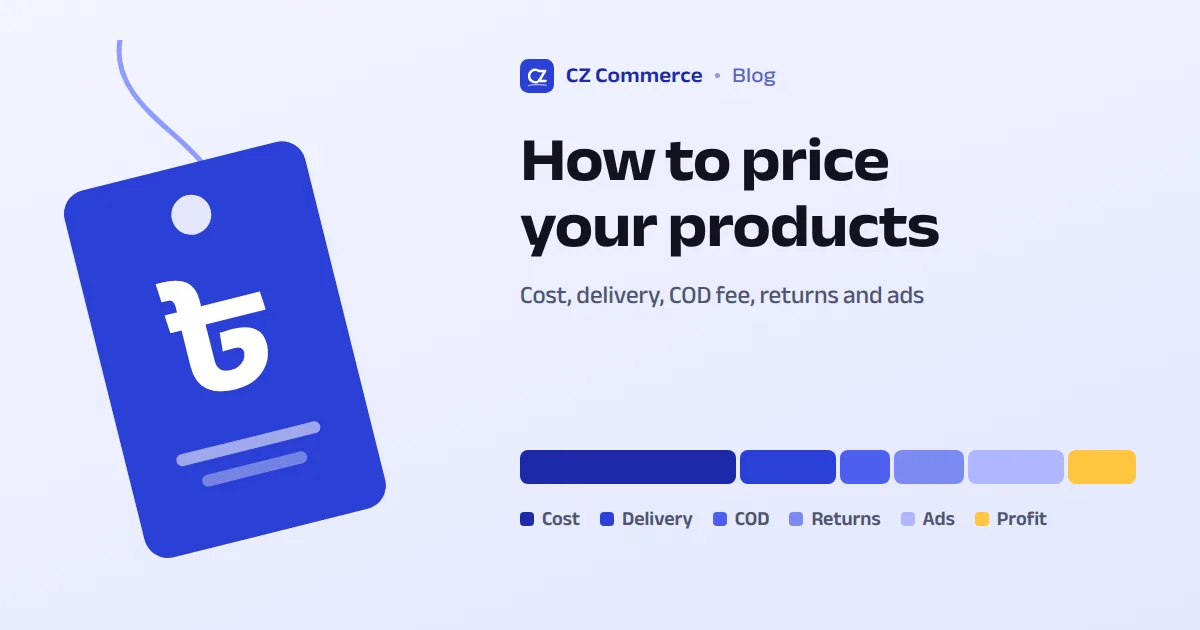
“I buy it for ৳450 and sell it for ৳990, so that’s ৳540 profit!” Then at the end of the month the bank balance says otherwise. The courier took its cut, a few parcels came back, the ads cost money, and so did the packaging. The profit was there on paper, but not in your pocket.
When most of your orders are cash on delivery, the real pricing question is this: what does one order cost you, all the way until it is delivered and the money reaches you? This post breaks down each cost, then puts them together in one worked example.
The real cost of one delivered order
A typical order carries these costs:
- Cost price: what you paid to buy or make the product, including getting it from the supplier.
- Packaging: poly bags, boxes, tape, stickers, the printed invoice.
- The courier’s delivery charge: what the courier charges you, which depends on area and weight.
- The COD fee: the percentage the courier keeps for collecting cash from the customer.
- Return losses: for parcels that come back, the courier charges both ways and the packaging, sometimes a damaged product too.
- Ad spend: what you spent on Facebook boosts and ads, divided over delivered orders.
On top of that come monthly costs like rent, staff and phone bills. These have to be paid from your monthly profit target, so keep them in mind when you set that target.
Delivery charge: what the customer pays
The first decision: does the customer pay delivery separately, or is it built into the price?
- A separate charge: the most common way. The customer sees the product price, and the delivery charge is added at checkout once they pick their area. If your charge is close to what the courier charges you, delivery is roughly break-even.
- By area: different charges for Dhaka city, around Dhaka and outside Dhaka, matched to your courier contract.
- By weight: couriers charge more for heavier parcels. If your charge ignores weight, you quietly lose money on a 3 kg parcel.
- Free delivery: the courier’s whole charge is now yours to pay. Rather than offering it on every order, set a minimum so the extra margin on bigger orders covers it.
Courier rates change over time and every merchant’s contract is different, so we don’t quote any courier’s prices here. Use your own contract’s rate card for the math.
The COD fee: the 1% that’s easy to forget
From the cash the customer hands the rider, the courier keeps a percentage and pays you the rest. It is usually charged on the whole amount collected, that is the product price plus the delivery charge.
The rate depends on the courier and your contract. As one example, Paperfly’s charges page (checked October 2026) lists a 0% COD charge within the same city and 1% for suburbs and other districts. Check your own contract for your courier’s rate.
1% sounds small, but on ৳1,110 collected it is ৳11, and over 300 orders a month it adds up to a few thousand taka. So it belongs on its own line in your pricing.
Returns: the cost hiding behind your delivery rate
A returned parcel doesn’t just fail to make a sale; it costs you. The courier charges for taking it out and bringing it back, the packaging is wasted, and sometimes the product is too. And that loss has to be paid from the profit on the orders that were delivered.
Work it out like this:
- Look at last month: how many parcels you sent and how many came back.
- Find the average cost of one return (courier charges both ways + packaging + damaged goods).
- Divide the total return cost by the number of delivered orders. That is the return share per order.
The most effective way to cut returns is not the price but how you take orders: confirm them, ask for an advance on doubtful numbers, and keep size charts and photos honest. The full playbook is here: how to stop fake cash-on-delivery orders.
A worked example: a ৳990 product
Step 1: ad spend per delivered order
Many sellers count ad cost “per message” or “per order”. But money only comes from orders that are delivered. So:
Ad cost per delivered order = total ad spend ÷ delivered orders
Say ৳6,000 of ads brought 40 orders. 6 were cancelled when you called to confirm, you shipped 34, 29 were delivered and 5 came back. Your ad cost per delivered order is ৳6,000 ÷ 29, about ৳207, not the ৳150 “per order” it first looks like.
Step 2: every cost of one delivered order
Now take the same ad example. Every number here is an example, not any courier’s actual rate:
- Selling price ৳990; the customer pays ৳120 delivery outside Dhaka, so ৳1,110 is collected.
- Say the courier also charges you ৳120 for this parcel, so delivery breaks even.
- Cost price ৳450, packaging ৳15, COD fee 1%.
- One return costs ৳180 in courier charges both ways plus ৳15 packaging, ৳195 in all (assuming the product comes back in good shape).
| Per delivered order | Taka |
|---|---|
| Selling price | ৳990 |
| − Cost price | ৳450 |
| − Packaging | ৳15 |
| − COD fee (1% of ৳1,110) | ৳11 |
| − Return share (5 × ৳195 ÷ 29) | ৳34 |
| − Ad spend (৳6,000 ÷ 29) | ৳207 |
| = Real profit | about ৳273 |
Over 29 delivered orders that is about ৳7,928 in profit. The “৳540 profit” on paper is really a little over half of that.
Now look at what two “small” decisions do, with the same orders:
- Cutting the price by ৳100 (to ৳890): profit per order drops to about ৳174, about ৳5,057 in all. The price fell 10%, the profit fell 36%. To earn the same, you’d need many more orders from the same ad money.
- Free delivery at ৳990: the courier’s ৳120 is now yours to pay, and total profit drops to about ৳4,483.
And in this example, below roughly ৳714 every delivered order loses money. That’s your “never below this” price. Run the math once with your own numbers; it pays off every time you plan an offer.
Protecting your margin without raising the price
- Take an advance. Even an advance of just the delivery charge cuts fake orders, and if the customer refuses the parcel, at least that money is with you.
- Make combos. A saree and blouse together at a slightly lower price sells more in one parcel, with one packaging and one delivery cost.
- Put a floor on free delivery. Set it a little above your average order and customers add one more item.
- Give discounts with a minimum order. Decide the maximum taka a 10% discount can be, and the order size it applies from.
- Enter weights properly. For heavy products, charge the customer the extra per kilo.
Where CZ Commerce shows these numbers
On CZ Commerce, most of this math sits in one place:
- Cost price: each product variant has a “Cost price (৳)” that customers never see. The cost price at the time of the order is stored with the order, so later price changes don’t rewrite old figures.
- Delivery charges: zones set the charge by area, an extra charge per kg above 1 kg, and free delivery above an amount you choose (delivery charges and zones).
- COD charge: in Settings › Couriers, on the “Checkout & charges” tab, each courier has a COD charge % (1 to start with, adjustable from 0 to 10). When a courier doesn’t report a parcel’s COD charge (Steadfast never does), the dashboard’s money figures take this % off and count those parcels as estimated (COD charge).
- Where the money is: the dashboard’s “Cash received” counts the parcels couriers reported delivered, after the courier’s charges, so it is what should reach you; “On the road” shows what is still to collect on shipped orders. Its “Sales” is the product price after discounts, without the delivery charge. What a courier actually paid you, you match against its own payout statement: book couriers from one panel and reconcile COD payouts.
- Net profit: sales of delivered orders plus the delivery charges their customers paid, minus cost of goods, courier charges, courier charges on returns and packaging per parcel. Ad spend is not in it; take it off yourself as above. At the time of writing, net profit reports come with the Growth and Pro plans (net profit).
- Advances, combos and coupons: an advance can be just the delivery charge, a fixed amount or a percent of the total (advance payment). Combos are on every plan. Coupons can be a percent (with a maximum discount), a fixed amount or free delivery, with a minimum order; at the time of writing coupons are on Starter, Growth and Pro.
For what each plan includes and current prices, see the pricing page.
Wrapping up
A good price isn’t the lowest price; it’s one where every delivered order still leaves a profit after returns, ads and courier charges. Plug your own five or six numbers into the table above once, then check it every month. If you like, open a store on CZ Commerce’s Free plan and enter your cost prices and delivery charges to see it in action; no payment is needed to start.